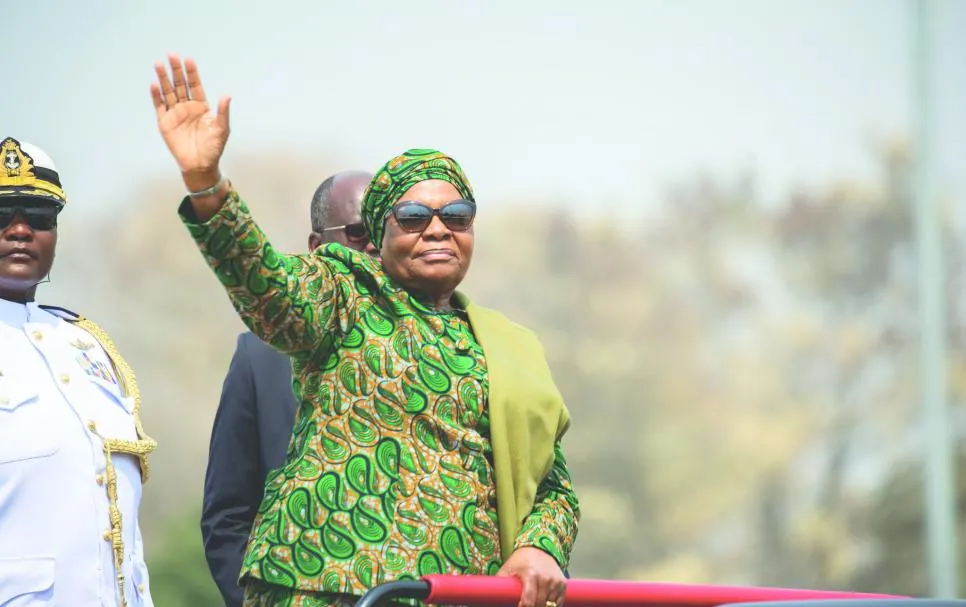
Windhoek, 19 November 2025 – PRESS AFRICA – At 72, Netumbo Nandi-Ndaitwah became, on 21 March 2025, the first woman to take Namibia's presidency. Her political career, marked by exile, the struggle for independence and then numerous ministerial responsibilities, makes her both an emblematic and an experienced figure in Namibian governance.
Youth and early commitment
Born on 29 October 1952 in Onamutai, then in "South West Africa", she is the ninth of 13 children. Her father was an Anglican pastor. In her teens she joined SWAPO (South West Africa People's Organisation), the liberation movement, which led her to become actively engaged against South Africa's apartheid regime.
In 1973, in the face of repression, she went into exile. During her years in exile, she studied abroad: a year in the Soviet Union, then in the United Kingdom, where she obtained a master's degree in diplomatic studies. These experiences shaped her profile as a diplomat and career politician.
Political career and responsibilities
Since Namibia's move to independence in 1990, Netumbo Nandi-Ndaitwah has held a range of posts:
- Member of the National Assembly since 1990.
- Minister of Women Affairs and Child Welfare (2000-2005); Minister of Information and Broadcasting (2005-2010); Minister of Environment and Tourism (2010-2012); Minister of International Relations (2012-2015, then 2015-2024) and Deputy Prime Minister from 2015.
- In 2017, she became vice-president of the SWAPO party, the first woman to hold that role.
- In November 2024, she was elected president with around 57% of the vote, becoming Namibia's fifth president and the first woman to hold the office.
Her rise to the presidency came with a message of continuity and reform. In her inaugural address, she said that "the work that lies ahead is to preserve the gains of our independence … and to ensure shared prosperity".
Priorities for her term and main challenges
At the start of her presidency, Netumbo Nandi-Ndaitwah set several key priorities, notably: diversifying the Namibian economy, which is still heavily dependent on mining and export resources; creating jobs on a massive scale for young people, as youth unemployment remains a major challenge in a country of about 3 million people; reducing inequality, in a context where Namibia is among the most unequal countries in the world; and more efficient management of the state, with the cabinet cut to 14 ministers and 7 deputies, promoting leaner governance.
A symbol of progress for women
The election of Netumbo Nandi-Ndaitwah marks a major turning point for Namibia and, more broadly, for southern Africa. By becoming the country's first female president, she sends a strong signal about the place of women in political life. She herself has said she wants to be "judged on her competence, and not only because I am a woman".
A critical perspective
Despite her solid CV and political longevity, some challenges remain to be overcome: the SWAPO party, in power since 1990, is seeing its popularity decline; the 2024 elections suffered logistical failures; and her term will have to be judged by concrete results: job creation, reduced inequality and a better distribution of wealth.
Netumbo Nandi-Ndaitwah embodies both the legacy of Namibia's struggle for independence and the promise of renewed leadership. Her journey, from young activist in exile to head of state, illustrates the political maturing of a country born in 1990. Her term opens a new era: that of a Namibia seeking to combine stability, social justice and economic transformation. But as is often the case, the stakes are high, and only time will tell whether this presidency marks a turning point in the country's history.
Writer: Saïd TESSILIMI

Leave a Comment